Showing posts with label spring western new york painting. Show all posts

Sunday, November 08, 2009

Fall #9 Gray Sky


8x8
oil on canvas

In this painting I wanted to convey the dense fall treetops outside my studio window,
the muted, bluish trees on the horizon, and the particular gray of the sky that day. It
was a purplish haze, complementing the warm, mainly yellow middle ground. It is a quiet
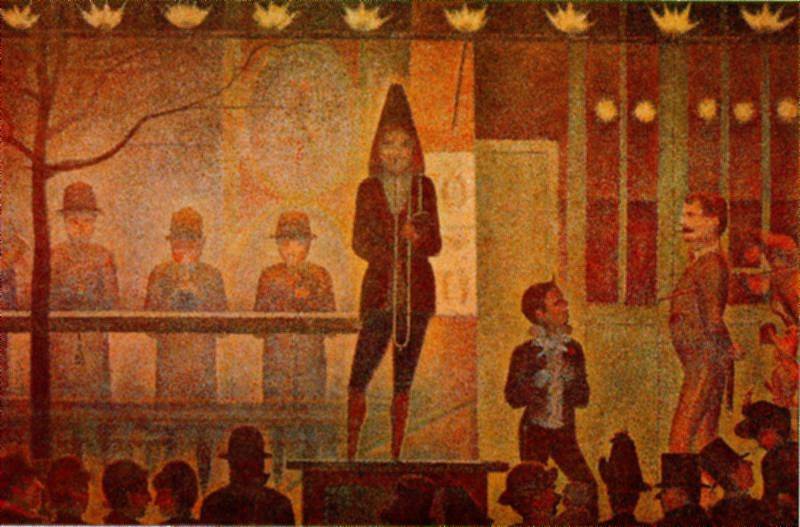
little thing with bounce. Seurat worked with Pointillism in a very different way. First, he
didn't really paint complete circles but rather used short brush strokes. Secondly, he was
very aware of the edges between things. He defines form while also diffusing it, which
I do, but he has a much harder edge. The daylight paintings like A Sunday on the
Grande Jatte retain a softness because of the light quality and a rather tender manner
of applying the paint. His night paintings like The Side Show or the painting The Circus
tend to have harsh light and the paint application is different, more graphic, I think. My
work usually isn't so hard-edged, more concerned with paint handling than tight form.
Tenderness really comes through in his drawings, a quality perceived by art critic
Michael Kimmelman. At a lecture at the Memorial Art Gallery in Rochester, I asked
him what art moves him the most and he said Seurat's drawings, the "why" we didn't get to.
The drawings have the feeling of a photograph, not at all in the amount of detailed
description but in the feeling of a moment in time, a concept true to the origins of
Impressionism. Their tonality and softness captures this to more of a degree than his work
in color. I think my September self-portrait depicting myself as shadow is similar in intent.
It is not always easy to discern the subtler qualities between oneself and others, not just in
art, but it is important in defining oneself. "She paints with dots" is about as informative
about what I do as "she is a basketball player" is to conveying who a person is. Trying to
convey what I do in words is so difficult that it takes weeks of circling around it
in this blog to come close. Sometimes I think I should just post the pictures.

Sunday, June 28, 2009

Spring #11 May Field


oil on panel
6" x 12"

  "I can do whatever I want any old time."

  Post-modernism is a distrust of established canons in art but not limited to art.  It re-evaluates all western values.  The effects of this movement caused a paradigm shift prompting discord with conservatives here and abroad from right-wing Christians to the Taliban.  Examples of artistic deconstruction of traditional artistic practice are the Dada Movement (Duchamp), Fluxus, and Performance Art to name a few.  One act which shocked and then delighted me is when in 1952 Willem DeKooning erased a Robert Rauschenberg drawing.  It seemed like vandalism rebelling against a statement, negating it, pushing a fellow artist off the top of a mound like an alpha male. It was a collaboration, Rauschenberg approached DeKooning who didn't like the idea, reconsidered, and then said he wanted it to be "something he would miss."  It is an example of letting things go.  In drawing one can erase as much as draw, and additive and subtractive method as in sculpture, so this action still has its roots in traditional art.  DeKooning picked a picture with oil paint in it so it took Rauschenberg a month to erase it.  The work elicited a scandal. This interview with Rauschenberg about the event is very interesting.

  My work is fairly traditional as all painting tends to be seen now.  I vacillate in my approach as I don't feel the need to adhere to any rigid definition and can paint as I please.  While I have responsibilities like everyone else, artistically I feel as the Rolling Stones say in I'm Free, "I'm free to do what I want any old time."  It's something one wants to shut.  Even if one's song (one's creative output, oneself) is imperfect, out of time, there is value in it.  Written in the sixties, the song's reference to love reflects the need for acceptance despite social rebellion, the desire to be loved as is.

  On one of his visits to Penn, painter/teacher/critic Andrew Forge asked all of us young painters if we could think of a painter who Pollock [a fun Pollock inspired website lets you move your curser to make Pollock drip patterns] makes us see in a new way.  Also what particular qualities do we see anew?  The questions show how contemporary life can inform how we view history just as history reaches out into the present.  It is impossible to be extricated from one's time.  I said that Pollock changes how we see Vuillard in terms of passion and movement in paint handling as well as pattern.

  Despite artistic freedom, our time leaves its mark.  It is said that Americans have such a rich range of experiences and viewpoints but when an American is in a different country, say a Texan and a Connecticut Yankee, they are unified and easily identified by some quality that is strictly American.  My work shares this phenomenon.  It is American but its hard to say why.  Maybe its the aspect of freedom and the particular places I paint.  While having parameters, a set of "givens" (elements of design, a surface to paint on, etc.) there is choice.  "I'm free to do what I want..."

Sunday, June 14, 2009

Spring #9 (So Many Greens)


18" x 24"
oil on panel

As I paint dots I'm looking at other dots in paintings as well as references to circles in all the arts.  Aboriginal paintings from Australia are typically constructed of dots.  Some are done on bark. The bark connotes such a strong connection with nature that it is the substance of the image. Rather than depicting their surroundings in a literal way, the subjects are abstracted but often show nature via animals, fish, people, etc.  I found a source for their symbols.  The Kluge-Ruhe Aboriginal Art Collection at the University of Virginia has the largest collection of indigenous Australian art outside of Australia. 

Spring #9 (So Many Greens) draws heavily on visual perception done from direct observation, thus differing from Aboriginal art.  The commonalities are rhythm, nature, immersion in a particular place and way of life, and the abstract element of the dot as a vehicle for these things.  The greens can be spliced and spliced towards yellow, blue, violet, light and dark, etc.  Even the most representational painters have to simplify.  My family often looks out on such scenes from our dining room window as we eat meals together.  My son says that the greens are actually overwhelming from the window view but not when one is outside.  It is funny but it is like being overstimulated by flashing lights in a big city.  The painting is perhaps a bit less hyperactive due to its abstraction/simplification, my processing.  Some dots are more subtle than others like the ones in the sky.  I'm looking forward to looking at it through the winter.

Sunday, May 17, 2009

Spring 2 (View From the Cobblestone School Playground)

oil on canvas
24" x 20"

I really like this purple house sitting beyond the green.

*****************************************************************************************

The paint gets very thick when I paint over old paintings. It reminds me of the Californian painter Jess as well as passages of heavily layered gouache (opaque watercolor) in the paintings of African-American artist Horace Pippin (1888 - 1946). There isn't a lot of air in Jess' paintings; they seem locked in, constructed of bumpy jigsaw pieces. Many of Pippin's paintings depict the bleak interiors of African-American homes he experienced in his lifetime. He frequently used flat shapes but his space is often airy however stark the scene. What I am talking about is very physical. I am beginning to work on clay reliefs which naturally connect to this idea. They will appear here if I am able to pull it off.

My physical and airy painting, Spring 2 (View from the Cobblestone School Playground), is exuberant. It is the moment when all of Rochester is altered into collective cheer at the sight of green. The grass is green first, which means the leaves are soon to follow. Old buildings that looked dingy under gray skies now sparkle in the sun. It has the excitement of Dippin' Dots (frozen tiny balls of ice cream that look like Styrofoam pellets) at the amusement park. Although totally artifice as the loud circles proclaim, it generates strong feeling. The form of the landscape is changed to mirror emotion.

I think the dots can sometimes be like a kind of collecting, think bottle caps, stamps, buttons. When I was a girl my passion was stickers. For years my allowance went to magical eye-candy that I loved to organize (this zeal for page layout may have served me well in many graphic design scenarios, but has recently intensely resurfaced through an innocent-looking recipe organizer given to me by a friend). I collected until adolescence, at which time I promptly gave them all, numbering in the thousands, to a woman with two daughters younger than me. It was an impractical past-time as a well-meaning aunt expressed, "All it is is a shiny piece of paper," a quote I remember from over twenty-five years ago. Blasphemy! She didn't understand the brain buzz (play Zynga's Scramble if you want a taste), the visual information I could process, finding comparisons and contrasts in shape, color, scale, texture, and sometimes even scent (scratch and sniffs were prizes given by my teachers). It is one kind of intelligence, which I often use to explain why the math section of my brain is the size of a raisin. Some kids were practicing piano, others dance or baseball, while my independent investigations of paper and design were in preparation to create this Dippin' Dots picture for you. Yum.