Showing posts with label fall landscape. Show all posts

Sunday, November 08, 2009

Fall #9 Gray Sky


8x8
oil on canvas

In this painting I wanted to convey the dense fall treetops outside my studio window,
the muted, bluish trees on the horizon, and the particular gray of the sky that day. It
was a purplish haze, complementing the warm, mainly yellow middle ground. It is a quiet
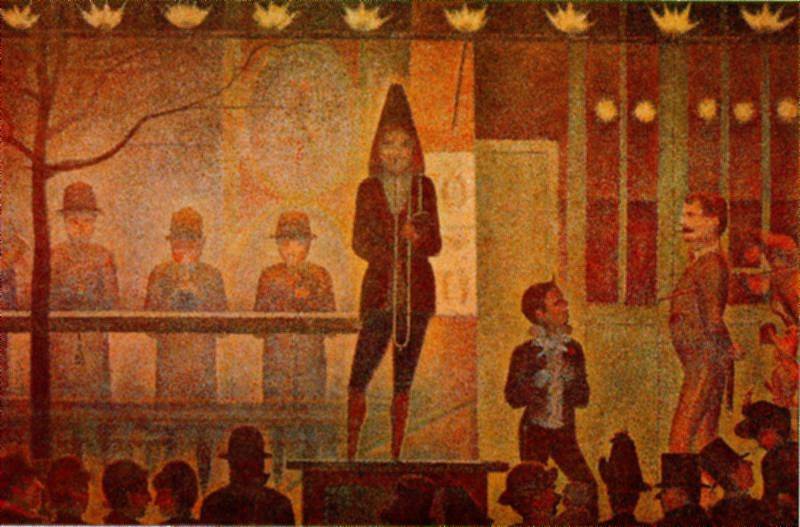
little thing with bounce. Seurat worked with Pointillism in a very different way. First, he
didn't really paint complete circles but rather used short brush strokes. Secondly, he was
very aware of the edges between things. He defines form while also diffusing it, which
I do, but he has a much harder edge. The daylight paintings like A Sunday on the
Grande Jatte retain a softness because of the light quality and a rather tender manner
of applying the paint. His night paintings like The Side Show or the painting The Circus
tend to have harsh light and the paint application is different, more graphic, I think. My
work usually isn't so hard-edged, more concerned with paint handling than tight form.
Tenderness really comes through in his drawings, a quality perceived by art critic
Michael Kimmelman. At a lecture at the Memorial Art Gallery in Rochester, I asked
him what art moves him the most and he said Seurat's drawings, the "why" we didn't get to.
The drawings have the feeling of a photograph, not at all in the amount of detailed
description but in the feeling of a moment in time, a concept true to the origins of
Impressionism. Their tonality and softness captures this to more of a degree than his work
in color. I think my September self-portrait depicting myself as shadow is similar in intent.
It is not always easy to discern the subtler qualities between oneself and others, not just in
art, but it is important in defining oneself. "She paints with dots" is about as informative
about what I do as "she is a basketball player" is to conveying who a person is. Trying to
convey what I do in words is so difficult that it takes weeks of circling around it
in this blog to come close. Sometimes I think I should just post the pictures.

Sunday, November 01, 2009

Fall #8 Clouds in the Middle


10x8
oil on canvas, PRIVATE COLLECTION


The photographer Alfred Stieglitz (husband of Georgia O'Keefe) is famous for promoting American Abstraction in his galleries 291 and An American Place and for his photographs of clouds, which he named Equivalents. Music: A Sequence of Ten Cloud Photographs (also called Clouds in Ten Movements) walks the line of representation and abstraction. Photography, often used to document, was not yet used to explore abstraction in the same way the American painters did. Clouds were a subject both tangible for the camera and amorphous.


Painters don't just look at the total image of a painting but look at paint passages. In Stieglitz's photographs this meant the textures of the clouds and sky and the actual physical substance of print and paper, its particular qualities. Passages are like phrases in music or a line or two of a poem, non-verbal and fully of the particular language of the medium. They convey a lot of information about the approach and attitude of the artist in the work. To the painter-viewer, sometimes thrilling, juicier paint feels like candy, visual caffeine. Paint surfaces are only truly observable in seeing in real life, "in the flesh". Painters actually call the surface of a painting its "skin". It is sensual and holds the content of the work. Paintings that miss the mark for me are disappointingly dry, dead, lacking in sensitivity. It is easy to do this in political work in which the message sometimes overtakes the paint handling. The message is loud and is focused on something else. The art image may still be great but it is not of the kind of painting that makes me tick. An example is Barbara Kruger's work, which would be ineffective in the medium of paint. Diego Rivera painted enormous politically fueled murals but he had a painter's heart and managed to do both. Andy Warhol's genius is in his societal commentary/observation, graphic sensibility and snap. I love his work but if the museum was burning I'd probably run away with this Bonnard (Nude in the Bath and Small Dog). It's like saving family over a book you respect and with Warhol, production is such a theme that there are so many similar pieces in other places.

Fall #8 Clouds in the Middle is a relative of Stieglitz and Bonnard but is my own. Love that paint.

Sunday, October 11, 2009

Fall #7, October Sunrise


oil on panel
18x24

This is done the same day from the memory of looking out the window at approximately seven a.m. at the sunrise. A golden light came across the treetops, the grass was pale and cool, and the sky light pale blue-violet to violet. The color moment seemed so short compared to the rest of the day. I knew how I wanted to do it.

Dots are like the cherry on top of an ice cream sundae, of supreme importance, bright, celebratory, and excitement inducing. They are tempting but the rest of the picture also has something to offer.

In graduate school I painted a portrait of a fictional person. The painter Jake Berthot saw it and told me that I needed to paint the whole thing with the attention I paid to the woman's earring, a roundish piece of green. It was not to say that the whole painting needed to be made of that shape but that that piece of paint conveyed more in its delivery that the rest. Painters need to make sure that paint passages aren't just filled in areas like a coloring book but are functioning parts of the picture. This doesn't mean that all parts need to have the same thickness or level of description or saturation of color; it is a bit tricky. It is kind of like paying attention to someone else as an active listener and not zoning on parts of the conversation. I think I have learned how to do it and this painting is an example. Another example is this drawing of trees by Matisse. Even though it is made of simple lines, the negative spaces are considered. The space between the trees, for instance is hour glass shaped, echoing the curvy trees and complimenting their duality with the upper and lower parts of this shape, two for two.

If you look at this fabulous jpeg of Shoes by Van Gogh, 1888, you will see what I mean. Check out the floor. This reproduction is big enough to get into the paint passages. I can't get enough of it. You can see his thinking as he defines planes, observes variation in color, and physically describes the turns of the leather, it's facets made by the form of a shoe and the history of the individual wearer. It makes them a kind of portrait, intimate, through the appreciation of this everyday object and the life it represents. It is done with the care and tenderness one regards the clothing of loved ones who have passed and we have the sometimes difficult decision of keeping or donating them. People are passionate about Van Gogh because he understands this. He paints what he can't hold onto. The subject is shoes, the content is life.