Showing posts with label fall. Show all posts

Saturday, December 18, 2010

iPad Advent Calendar!


Fall Pine #1


Check in daily to Art Weekly for an iPad Advent Calendar! Each post will feature one or more of my artworks done on the iPad using the apps Brushes, Sketchbook Pro, Inspire Pro, Art Studio, or Type Drawing.

Sunday, November 29, 2009

Yellow Arch


8"x 9"
watercolor

This painting is about bright fall days, crisp blue skies, and growing things. The dots are appropriate in the sense of jubilation they convey. The focal point is the white area under the center of the trees where the green converges and the blue slips down. Different elements come together harmoniously. It is not a painting about problems - world problems, personal problems, worries. It is a release from worries.

"WHAT I dream is an art of balance, of purity and serenity devoid of troubling or depressing subject matter, an art that might be for every mental worker like an appeasing influence; something like a good armchair . . ." - Henri Matisse

If anyone checks out my blog of archives, Before Art Weekly, they will see that aligning with Matisse's philosophy isn't always my goal. I've painted my night terrors. My more recent work, including this painting, is not about the upset. I think it is important to be restored. I'm not out to be your hot tub are equivalent, but to represent the beauty I experience in hope that you see it too. I'm imagining it but I'm not imagining it. Dreams are like that.

Sunday, March 08, 2009

Window (Late Fall)


oil on panel

24" x 18"


I recently commented on Vermeer's View of Delft. Another thing, among many, I like about his paintings are the way he treated windows and light. He painted many domestic interiors including solitary women. The window is secondary to the figure, but it is the source of the beautiful light that tenderly illuminates the woman. Unlike Renoir who portrays women as ornamental (basically the only thing I like of his are the peaches which are as boobilicious as his nudes but not offensive to the feminist), it seems that Vermeer respected women. It is the difference between the derogatory term "soccer mom" and mentioning Michelle Obama's name.

This issue concerns me as a mother who is very domestic, shuffling between the studio and kitchen. I love both and don't like my mother/wife role to be dismissed as lesser than my husband's as breadwinner. In this context my vocation as an artist sometimes is perceived as a hobby, especially if the conversation turns to sales and other marketplace-based evaluation. Luckily it doesn't seem to happen as often as it used. Enough venting, I'll leave the rest to Whitney Chadwick who addresses gender roles and societal views in her book, Women, Art, and Society. To be fair, I've heard a musician say that people equate his profession with unemployment and an actor in New York City with waiting tables.

On the male experience of the home and workplace, I found out about an early telecommuter before the "tele". 2009 is the bicentennial of the birthday of Charles Darwin. A recent BBC program, In Our Time with Melvyn Bragg, focused on Darwin's domesticity. He lived in the country with his wife and children in a home where he based his laboratory and garden used for his experiments. Apparently this quiet setting and family support fostered his studies.

Domesticity is the back story to Window (Late Fall), another view from my bathroom window. The landscape, this rectangle, glows. It is like stained glass when fully illuminated by the brightest day. The landscape is far, based on its scale, but then it overtakes you as it presses forward into your space before receding again. The landscape is burned into my retina, seen in quiet moments between the laundry.

Sunday, February 08, 2009

The Neighbor's Shed


36" x 24"

oil on panel

Okay, you might notice this is a fall painting when we are in winter. I did an oil pastel of the view out one of my studio windows and this is a painting done from the drawing. I think the dots are kind of perky, not in a bubblegum snapping teenager way, but in a playful way. Rather than crunching leaves, one feels as if it is possible to bounce on the treetops like with moonboots. This playfulness is a quality that keeps the work, harkening back to Pointillism, from being dry and redundant. A fellow student in art school complained on our trips to the museum that it was "like going to a cemetery. It is full of dead art by dead artists." Perhaps some artists might agree, maybe those trying to find the cutting edge. For me the art is timeless while of its time, as full of life as Mozart is today.
The neighbors put up a new shed and it creeped into my work. The Post-Impressionists found Impressionism limiting because the short marks didn't lend themselves to clearly defining form. It was almost a focusing problem. Cezanne delineated form, but I think his bathers walked the line. I didn't want to make the thin trees out of dots and used line with dots weaving in and out of them. I see so many variations in the color of what I am looking at that I am not always content to make one or two stand for all, thus this pixelization. This painting makes me think of Pissarro, especially one at the Guggenheim, The Hermitage at Pontoise, where I studied how he handled paint. His work strikes me as quieter than a lot of the other Impressionists, a little less bang, but the paintings are very thoughtful, carefully and beautifully seen and made. If you check out this painting: Landscape at Chaponval, you can see what I admire about his treatment of houses in a landscape. I like the way they are nestled there, part of the patterning of the picture with the greenery coming in front of, behind, and through. Imagine what would have happened if he had heard rock 'n' roll?!

Sunday, January 04, 2009

Late Fall 2

oil on canvas
40" x 28"

More gumballs! Well, they're not really gumballs, but they do make me think of the game of guessing how many jelly beans are in a jar. The dots are compressed toward the picture plane, accentuating the surface of the canvas. The edging on three sides sets them back a bit, setting up a dialogue between in vs. out, the world of circles as opposed to something else.

Dots of fall treetops are layered on the bottom like piles of leaves while the second fourth of the painting shows the darker structure of bare trees. The third fourth is made up of blue and white (falling snow or cool air?), while the upper fourth is an attempt at the many varieties of crystalline blue there are no paints for (sigh). The height of the canvas compared to width is important as the circles are like bubbles. They have a good enough length to travel and convey their effervescence. When looking at the actual painting (I'm not sure it works in the jpeg) one's eyes dilate, getting lost in the movement, stimulated by the bouncing color.

For all the special effects computers offer in pixelization and making things random, less mechanical, more naturalistic, a computer could not make this painting. I work intuitively, sometimes impulsively, and sometimes calculated. I think the location and color of the dots (or other design elements I use in other pictures) end up conveying my personal energy and the feeling I am expressing. A friend's parent in 1989, when I was in high school and deciding to go to art school to study painting laughed at my decision, saying that computers would make all the art of the future. It is like saying we would happily accept the superiority of the machines we create. Our souls could give up, obsolete.

Sunday, December 14, 2008

Late Fall


oil on canvas
36" x 42"

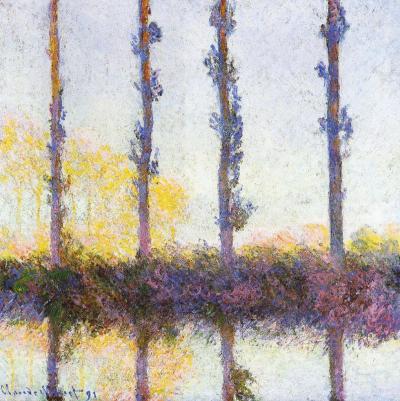
The column filled with gumball-like multi-colored dots gets narrower on top, channeling movement. Optics are a big part of the painting, and I was inspired by an artist once criticized as being a big eye because of his almost scientific approach to color and light. Monet's poplar trees, came to mind to solve the compositional problem of tree trunks amidst leaves. The four vertical streaks of brown/maroon dots add another structural element, in harmony with the three main vertical sections of the painting. Despite the formalities, Monet's paintings aren't cool and unemotional, and neither are mine.

Two black rectangles are like black velvet curtains drawing back to reveal the magical center stage (as close to painting on velvet as I will ever get). They also can be seen as pressing on the center strip, like shorter days in winter and the down turn of the news vs. optimism. I resist letting the dark news be the focal point. I prefer to stay in the frame of mind (I love the at phrase, "frame of mind", like your thoughts fit in a frame, which mine can do, and then there is thinking outside the frame/box...) that Barrack Obama eloquently presented in his acceptance speech as President Elect, "While we breathe we hope." Those dots move as though effervescent, breathing, whimsically bubbling upward. There is blue-sky air, a purple tonality to the bottom, and a golden tonality in the center. The black is not flatly painted but has texture, and colors from underneath richly peak through, signs that it is permeable, vulnerable.

Sunday, October 12, 2008

Fall Tree


16" x 20"
oil on panel
This is a celebration painting. The leaves in fall know how to go out in style. They make a final burst of color before their descent. Pierre Bonnard squeezed the last bit of life in himself just as he squeezed paint out of tubes in order to paint Almond Tree in Blossom. It was done the week he died. As such it deserves our special attention.
I recently saw the Julian Schnabel film, The Diving Bell and the Butterfly, made after the book of the same title "by Elle France editor Jean-Dominique Bauby, who, in 1995 at the age of 43, suffered a stroke that paralyzed his entire body, except his left eye. Using that eye to blink out his memoir, Bauby eloquently described the aspects of his interior world, from the psychological torment of being trapped inside his body to his imagined stories from lands he'd only visited in his mind. Written by Anonymous , IMDb"
While Bonnard uses his sight to make his last statement, he also uses his imagination and is aware of his mortality. Both Bonnard and Bauby embrace life, continuing to absorb and respond until the end, exploring their humanity, and the mystery of pain and beauty.
I am not in such dire straits, but this is my painting.