Spring Landscape #25 Yellow Green Tree, oil on panel, 12" x 12"
Art and science overlap but it is a little hard for me to delve deeply since I'm only expert on one side. Here goes:
Aristotle, 340BC) The first Science (Metaphysics) is universal and is exclusively concerned with primary substance.
What I can say is basic: even air is made of matter, a primary substance. Landscape painting is all about objects in air; objects having more density than air. It's hard to do, perceiving anew, not just following a formulaic cliche. That is the difference between what I do, what I seek, and "pictures of landscape" which may also be in the medium of paint. It's what keeps me from being a craft fair vendor. Not everyone notices the difference and I don't want my work to be mistaken for something less.
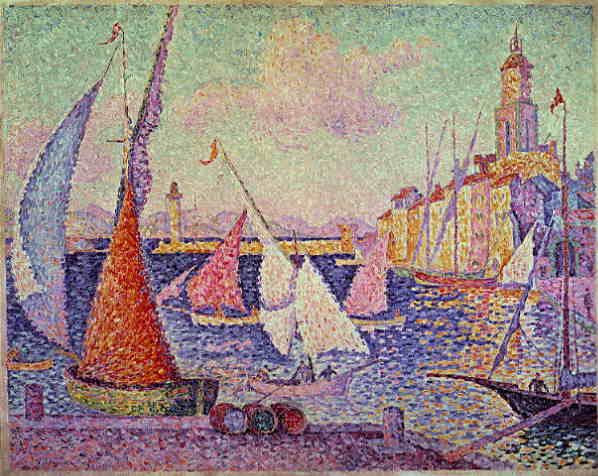
Lines do not exist between things. Impressionists* (Monet, Seurat, etc.) eliminated the line. Post-Impressionists (Van Gogh, Cezanne, Gauguin) returned to the line in order to define form more clearly on the two-dimensional plane. Monet and Seurat were two of the only Impressionists, in my opinion, to really push the elimination of line in favor of marks/color in space. Degas and Cassatt never let go, asserting solidity, in love with form and the figure.
My dots are like cells, units, maybe enormous generalizations of atoms. They are also like the stitches in a tapestry. I'm fascinated by the interwoven air and form and their color interaction. It was a challenge to find a way to articulate the tree in Spring Landscape #25 Yellow Green Tree and make it simultaneously be independent of and integrated with the foliage behind it. Art has its own way of mirroring science. Monet was criticized, called "an eye" for his scientific like approach to analyzing colored light. He worked on a new canvas each hour on site, returning on another day with similar weather conditions in order to capture the changes. His work is emotional despite the structured approach. My work is also highly structured, a measurement to placement of dots and their careful articulation (yes they're freehand, as I'm often asked). In this painting the sky is rolling like waves and the dots bounce around the space like foliage ping-pong balls.
Art's purpose is distinct from science. Writer David Shields quotes Samuel Johnson, "A work of literature** should either help us escape existence or teach us how to endure it." Shields adds his own response, "And the works that I love the most teach us how to endure it. To me, a crucial idea is this: that we are existentially alone on the planet, I can't know what you're thinking and feeling and you can't know what I'm thinking and feeling. The very best work constructs a bridge across the abyss of human loneliness." Shields' new book, Reality Hunger: A Manifesto, discusses literature's new role in connection to reality. Science and art, both investigating reality from different angles. Science is factual, art is involved with the perception of the factual which is it's own reality. Approaching a blank canvas is intimidating with this cooking in my brain. I'm off to take another stab at it.
*Wikipedia describes Impressionism: "Characteristics of Impressionist paintings include visible brush strokes, open composition, emphasis on light in its changing qualities (often accentuating the effects of the passage of time), ordinary subject matter, the inclusion of movement as a crucial element of human perception and experience, and unusual visual angles. The emergence of Impressionism in the visual arts was soon followed by analogous movements in other media which became known as Impressionist music and Impressionist literature."
**insert "art"
[For researching this post I went to Teachers' Domain, a website to help teachers use digital media in the classroom is great for explaining topics in science, art, social studies, language arts, and math to kids and adults who might have missed that day in school : ) ]