Trees #1
Check in daily to Art Weekly for an iPad Advent Calendar! Each post will feature one or more of my artworks done on the iPad using the apps Brushes, Sketchbook Pro, Inspire Pro, Art Studio, or Type Drawing.

This is an art archive by Nicole Maynard from 2005 until Jan. 2017. For recent work, go to nicolemaynard.studio Images may only be used with permission from the artist.


6" x 12", oil on panel
It's a December themed post this week. No snow here in Rhode Island yet except the white blanketed hills and sleigh bells I have in my head. The Nutcracker is there, too, specifically Tchaikovsky's Dance of the Sugar Plum Fairy. One could imagine a ballerina twirling around in a tulle skirt, flitting gracefully among the dots in Dreamed Winter like colored snow.
Damien Hirst puts diamonds on a skull and I'm talking about faeries. Everyone is charmed, enthralled, transported when watching The Nutcracker performed live. The music, dance, story, and set design leave our cynicism out on the brown snowed curb. Mr. Hirst can work with excess, a financial circus in art that is not without merit. I will be daydreaming all by myself.


 Windy
Windy


12" x 16", oil on panel
Reframing “American” Art was the topic of the National Public Radio show, OnPoint, this past Tuesday. Hosted by Tom Ashbrook, the guests were Elliot Bostwick Davis, chair of the Art of America’s Department at the Museum of Fine Arts Boston and Andrew McClellan, dean of Academic Affairs for Arts & Sciences and Professor of Art History at Tufts University. The occasion was the opening of the MFA Boston's new "Arts of the Americas" wing. Five hundred million dollars in the making, it houses approximately fifteen thousand works of art.
Some of the discussion involved how the exhibit reflects the United States' changing demographics and global awareness. Juxtaposing art from the U.S. with our neighbors can inform our identity. What is similar or dissimilar in the art and how does that speak to who we are? It can broaden our self concept, not unlike a child going to preschool to be socialized. The child learns about others, finds his/her place in the group and goes home to bring the new knowledge to the family (sometimes for better sometimes for worse!). The Internet sends us all to a virtual "pre-school" experience, allowing us to learn from one another well beyond the one-room school house. Maybe computers can't do it all. I believe it is short-sighted that geography is rarely taught in American public schools anymore. Our lack of education about other cultures is compounded by the physical location of the U.S.; disconnected from the other continents. We began by separating from Britain and turning away from the layers of European history ever present in the architecture of those places. The pioneers had a clean slate, a wilderness they felt compelled to claim and tame. Out with the old, in with the new. The new wing and the curators way of presenting the art is an opportunity to poke our heads up and see what was going on while we worked so hard. If we begin to consider the art of others as equal, we can increase our understanding and value of the people behind it.
Many American artists were viewed as pioneers. The first landscape painters were out to show Europe that although we didn't have its cathedrals we had something better - God's unspoiled creation. Alfred Steiglitz's 291 Gallery bridged the gap, showcasing American and European artists. Jackson Pollock and the Abstract-Expressionists put New York City on the map as the art capital of the world, pushing Paris to the side. A lot has happened.
I worked as a security guard at the MFA in college and had a lot of time to think about the collection. My husband and I met at the West Wing Entrance where I was selling admission tickets (May 1992). He was a visitor, a total stranger. A lot has happened. I just had to call in.
I was on hold when Ashbrook asked if there is any point in looking for commonalities between the art. He took my call. I said that certainly each artwork is it's own thing but the impulse for art-making is human and connects us. I said that Joseph Campbell made his life's work be the study of mythology of all cultures throughout the world and throughout history, including how those myths are represented in art. He found reoccurring symbolism on many levels. The collection lends itself to this exciting approach. For example, what does a portrait of Paul Revere, a Jackson Pollock painting, and a teenage museum visitor have in common (I promise I'm not setting you up for a joke)? Rebellion. The passion to challenge the rules. The will to make one's mark and envision a different world. There is great strength, determination, and perhaps some necessary pig-headed-ness mixed in as well.
So there you go. I'm going with my old art school buddy and I'll take my husband and son. We can think about who we were and who we are as we look.


Winter Memory, 6" x 12", oil on panel, 2010

Forest, Fields; 6" x 12", oil on panel, 2010
The work of children's book author Ed Emberley was recently featured in an exhibition at Scion Space in Los Angeles. Six artists responded to his pictures by combining their style with his. Emberley's Drawing Book of Animals was an absolute favorite of mine in third grade. Drawing instruction "how-to" books are usually poo-pooed for hampering a child's creativity, a principle I generally agree with. This was not my experience in the case of Emberley's, however. The book shows children on how to make his fanciful, graphic animals by building on basic shapes. The creatures are just plain cute and I remember giving the my drawing of the porcupine to my teacher. Children go through a phase of enjoying drawing characters as well as repetitively drawing schemas - a subject they draw in a particular way every time (mine were a clown, a fruit bowl, and a cat). Wikepedia defines "schema" as deriving from the Greek word "σχήμα" (skhēma), which means shape, or more generally, plan. The Free Dictionary adds that it refers to "a structural or procedural diagram". Emberley's book fits these definitions.
My landscapes are schematic in that I have a particular viewing experience in mind - a window/stage/framing like a screen. How I work it out isn't planned and can be a bit confusing, a puzzle, a challenge. I'm obsessed with the schema and want to push it in all directions as I repeat. Many painters did/do the same, revisiting a motif, banging it, bending it, pushing on it, trying to get it to give. Sometimes it comes easily, sometimes it resists. Either way it compels. I don't have a teacher anymore so I'll just pass them along to you.

View; 6" x 12", oil on panel, 2010
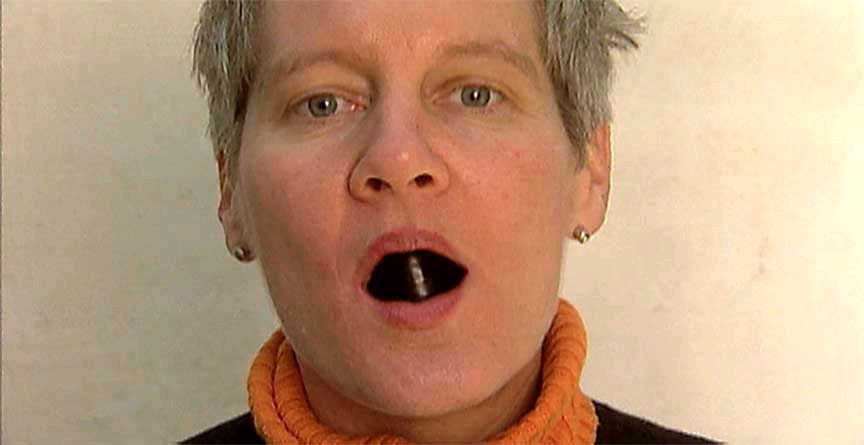
The well-known artist Ann Hamilton invented a special camera using her mouth. Her mouth is the camera body into which she inserts film. When she opens her mouth, it functions as a shutter to let in light. Intrigued by the idea of using one sensory organ to act as another, she combines the mouth with the sense of sight. The relationship of the body to taking the picture is different; it's not about eye-level. Hamilton creates people's portraits with her mouth camera. You can read PBS's Art 21 interview on the subject here. She has also written a book with Joan Simon titled Ann Hamilton: An Inventory of Objects which delves deeper into the project.
View has a similar kind of bracketing as the mouth camera portraits but the method, oil painting, is almost as old as the hills. Hamilton says the oval shaped pictures made from her mouth camera look like an eye, the person's portrait in the center, a "pupil". While not formatted as an oval, View, as with many of my paintings, is about the experience of looking out through something to what light reveals in the center. It is a particular favorite of mine because it looks fresh, free from labor, as if the subject was always there and you just came upon it. It feels as if you were lost in the woods and made it out, the black forms a bit ominous, the center a relief. It is a primordial world. The people in Hamilton's photographs are caught where they are, a part of their real selves captured in a blink. They are ready for a time capsule. My landscape is outside linear time, something that always was, the fruition of my search. It looks forward and back. Don't forget to change the clocks.