Saturday, March 31, 2007

Spring! [Intellect and Optimism Create Butterflies (after Goya)]


I am thinking a lot of Goya's The Sleep of Reason Produces Monsters from Los Caprichos. The title implies that losing touch with reality is a scary place. The figure is slumped over a desk, his garments making him into a winged form like the bat/owl creatures behind him. I thought to redo the picture, changing it to mean the opposite. I think it is important to change the word "produce" from the Goya to "create" as a more postive action rather than cause and effect. The mood of my painting is optimistic, celebratory for spring and rebirth, while Goya's monsters press on him in a nightmare. The figure in my painting is female and is vertical, active, lyrical in her pose. The form of her head surrounded by her arms is echoed by the center of the yellow flower surrounded by petals. The monsters are replaced by butterflies. The expressionist paint handling is energetic and relaxed while clear. The fluidity of the forms and their environment suggest harmony. Of course the painting is indebted to DeKooning.

Saturday, March 24, 2007

Sunset in Western NY (Rusty)


This painting came from taking out the garbage when the sun was setting and the moon was out. The turbulent landscape is in contrast to the monumental scale of my dog, Rusty, a Vizsla. I think of Egyptian sculpture and cat worshiping. No matter what adventures take me from home (beyond the exciting trash, that is), my dog is waiting.
Examples of good dog art:

Saturday, March 17, 2007

Self-Portrait Banded-Peacock Butterfly


etching, watercolor, 4" x 3" image size
Portraits often show people dressed in their best clothes. People from around the world identify themselves with particular animals. Here my butterfly obsession combines these two ideas as the butterfly operates as finery and a symbol for change and renewal. The particular butterfly this is based on, the Banded-Peacock, also alludes to the way a peacock takes pride in its ornamentation, which although decorative, is also part of its structure. The butterfly in my picture has been fused with my form, elongated in the process, making an elegant collar. The top part of the butterfly functions as a kind of headdress, making sense only in this printed world. I could make fun and say that these two forms can be compared with Princess Leia's hair buns or Mickey Mouse ears. Both comparisons are relevant in that the hairstyle and the mouse ears are adornment necessary to particular characters.
I am also very interested in Goya and his Los Caprichos. This print is going to be used as the introductory image in a series of butterfly themed prints that will be assembled as a folio in a small edition of ten. I am not sure how many images I will make for this project, but at least ten. Goya made eighty prints in each edition of Los Caprichos, which were sold at the time for what was the equivalent value of thirty-five dollars a set. The six sets he made for friends were of a higher quality than the ones for sale to the general public.

Monday, March 12, 2007

Grace


oil on panel, 20" x 20"
The position of the hands in this painting is sign language for "grace". The landscape is war-torn, contrasting with the title. One hand seems to have white feathers, like a dove (christian symbol for the holy spirit) descending on a bald head, perhaps a monk or a soldier. The bird-hand is semi-transparent, ephemeral, suited for the spiritual. Its touch has a rippling effect. The vertical hand seems to struggle with mortality, entropy. It feels like it is sinking, but it is resistant, elegant but raw.
In terms of composition, the square is essentially divided by an "x". The hand is in the upper left, while the head the lower right, forming one diagonal, while the winged hand makes the other.

Saturday, March 03, 2007

Passing the Butterfly


oil on panel, 24" x 18"
I'm sneaking another post in this week.

This candy colored painting started by covering the surface with dots. I was mindful of the delivery of each dot, like a violinist plucking individual strings. I also thought of Andrew Forge, whom I was fortunate to have critique my work in graduate school at U. Penn. I thought of him because of the picture's pointillist beginning and because of its meaning. "Passing the butterfly" is like passing the torch or the bar in a relay race. It is about inspiring one another and striving. Andrew Forge was a painter, art historian, and head of the MFA program at Yale for many years. He had a combination of brilliance, integrity, and humility that made every word he said precious. Even though I have only spent a handful of hours in his company, his life and work exemplified what an artist, a person can be when they live to their full potential.
There are many people who have helped me, and as I get older I am more willing to accept help. The butterfly is precious, unique, and vulnerable in its fragility, as are we as we extend ourselves and accept a hand from others. The lyrical colors reflect the content. The surrounding space shifts in this precarious transaction.

Friday, March 02, 2007

Home


digital image


This is a double self-portrait (figure in blue, larger figure sketched on left) along with my husband, son, and dog. The house is a part of my husband's torso, his head its apex, like a cross on a steeple. He is the symbol of home for me. One of my legs is an arm and hand. It touches the ground, showing that I am on sure footing at home, "walking on solid ground," so to speak. I like the change in scale between the interior and exterior figures as well as the flailing arms in exuberant greeting. This is as close to Hallmark as I get.


The style is somewhat Cubist. Two of Picasso's portraits of family were stolen this week from his granddaughter's home. http://www.nytimes.com/2007/03/01/arts/design/01pica.html?_r=1&hp&oref=slogin Their combined value of $66 million is hard to wrap one's head around.

Saturday, February 24, 2007

Butterfly Self-Portrait, Tailed Copper


16" x 20", oil on panel
The Tailed Copper Butterfly is not just brown, but rich in varying tones. The colorful segments reminded me of muscles and the Body Worlds Exhibition I saw in Toronto last year. The show made a lasting impression in terms of making anatomy more tangible as well as with regard to personal fitness. An increased awareness of my own muscles through weights and dance is also effecting how and what I am able to depict in paint. A figurative clay class while attending Massachusetts College of Art years ago stayed with me, particularly sculpting a head from life using calipers: from the skull to muscles to a likeness. As a drawing instructor, I have often used the skeleton as subject matter, a traditional but still effective challenge.
In this painting, the color and shape of the left butterfly wing give the feeling of skin being pulled back. The brown hair on the right and the butterfly body also double as rolled up skin. If this makes you squeamish, don't see Body Worlds!
I am turning away from the dark grotto-like space behind me. The butterfly bridges me with that space. It is a symbol of renewal, and here has the added layer of meaning of strengthening and rebuilding muscle. It is a hopeful picture. While getting older and relatively accepting of aging, there is much to do and I'm not willing to embrace entropy.

Saturday, February 10, 2007

Butterfly Box


oil on panel, 36" x 24"
Shape, symmetry, and asymmetry are important design elements in this work, as are nature and human control. The painting is split approximately in half vertically, with one side devoted to the grass and sky (albeit in rather synthetic colors), and the other half to the figure and house. The butterfly, box, and hands inhabit both.
We cannot tell the full expression of the androgynous person upon opening the box. The butterfly release could symbolize many things. The butterfly masks most of the person's features. It seems both beautiful and terrible, full of dichotomies like its stark coloring. The box is similar to the house in its neutrality and they could be figuratively, as well as literally, parallel in meaning. There is mystery and tension between what is visible and what is hidden.

Sunday, February 04, 2007

Hamadryas Chloe, Head, Feet


Oil on panel, 20" x 16"

The Hamadryas Chloe Butterfly is from Peru, although that is irrelevant to the image, I think. One can't be sure if the head has just flown off the figure or if it is separate. There is the implication of disjuncture, as implied by the title of disparate body parts. The figure appears to be dancing or skipping away. Memory, time, and dreams may have a place here. The blue monochromatic palette and stark contrast evoke melancholia. The butterfly and the human head are fused together, feeling tattooed, visceral, not at all disjointed. If there is loss or abscence, it is not between the butterfly and the head. The pattern seems beautiful and strong like a radiating spider web, more sturdy than a lace ruff (see links).
http://www.carts.org/images/rosa-elena/rembrandt.jpg
http://www.spanisharts.com/history/barroco/imagenes/rembrandt/estudiante.html

Saturday, January 27, 2007

Bring It On!


oil on panel, 24" x 20"

In this picture, it seems as though I place myself into one of my abstract-expressionist landscape paintings that I did for several years. My figure is amidst a turbulent sky, storm clouds mixed with sky blue and white, showing that change of one kind or another is always coming. I am weathered, facial lines are deepening. I stretch (in my exercise clothes), confident that I can meet whatever challenge blows my way. It is a cousin to Soutine's painting of children in a landscape:
http://www.artunframed.com/images/nov03/school.jpg
Speaking of change, confidence, and the ability to take on challenges, I am ecstatic that Hillary is running for President. I just ordered my bumper stickers. Go Hillary! http://www.hillaryclinton.com/

Sunday, January 07, 2007

Letting Out the Butterflies


1. digital image
2. dry point, 10" x 14"
About the image:
This is about letting the butterflies out of one's stomach, doing things despite a degree of nervousness. It directly relates to a specific experience that I had, as was pointed out to me afer I made it (again, one of the things I love about artmaking, my unconscious mind communicating to me). Over the holidays, a family member asked me and several others to help in recording a song he wrote. I have never had a voice lesson in my life aside from the minimal exposure that one gets in the public school system. While I enjoy singing, it isn't something I do well, and I particularly dislike performing things that I am not prepared for. This was a spur of the moment kind of thing. I thought I was going to be singing with the others, but when I stepped into the recording studio, I saw that I had to sing into an enormous microphone and wear headphones. Other voices would be edited in later. It was christian music and I was to sing "Praise the Lord" a couple of different ways. I did it, not without complaining, and enjoyed it dispite my distress. The butterfly is a christian symbol of resurrection. A snake is also a symbol for rebirth, and the pattern of the butterflies in the throat make the form snake-like. The butterflies seem like notes.
The experience was out of the ordinary for me, creating in a different medium (song) when I felt so flawed and human. Perhaps bringing it into the sphere of visual art allows me to put it into my own language, "singing" it with the clarity that I couldn't manage with my voice.
About technique:
I made the digital image first and then did the dry point. There are some differences due to the nature of the media. The digital has a free-flowing line, while the dry point is slightly more angular due to the way the etching tool has to incise into the metal plate. The dry point has beauty in the line quality typical of the medium with a fuzzier, thicker line due to the raised burr of the metal in places. I like the color of the digital and its starkness, but the atmosphere of the dry point is appealing, too. The hand has a different scale in the two pictures.


Sunday, December 31, 2006

Totem


oil on panel, 36" x 24"
PRIVATE COLLECTION
This follows a similar structure to the painting New Growth(see earlier post). I was reading Ayn Rand's The Fountainhead while working on this. The painting concerns itself with a similar theme as the book, regarding society building on the achievements of previous societies. The book sees this borrowing as lack of originality, and while I appreciate that aspect, I also see it as a passing on of the torch, so to speak. It really depends on a case by case basis.
The painting is an allegory. The upper hand reaches skyward, striving for excellence, and is concerned with vision as it comes forth from the head above the eye (eye = consciousness). The lower hand seems to struggle to grasp a snowy mountain peak, still making the journey. The African figure has a white eye mask, serving as the opposite of a blindfold, i.e. enlightenment. The black head/neck form a kind of totem pole that is primal, the eyes seeing in the dark (unconscious).
The painting is funny in that it could be about the duality and sense of purpose within one individual, while at the same time can be interpreted as the diversity and ambition of a group: policies and social orders are not always what they appear at face value, but may come from unconscious drives common to a society. [This could lead to discussions regarding Manifest Destiny, the Iraq War, Genesis and the environment, the manipulation of the masses in advertising, etc.] The painting is about the positive aspects of people and culture, but is not in denial that this tension with a more mysterious side exists. There is mystery in the psychology of the individual as well as in the psychology of the larger culture. It is so complex that discussion of it is really out of my range of expertice. I am better at painting the allegory, but this is a window into what I am thinking.

Sunday, December 24, 2006

Self-Portrait Spring Azure


oil on panel, 24" x 20"
Oh, look, it's another picture of me! I really don't own any of the "All About Me" line of clothing, but I suppose I might just as well.
It's funny, everytime I wake up, I'm there, and everytime I go to do something, I'm there; it's like I just keep showing up. I can imagine that one impetus behind Cindy Sherman's http://www.cindysherman.com/ work may be to be someone else for a change. Not me, though, I'd rather stick it out, accept my quirks, and wait for the wisdom that is supposed to come with age. If you are bored with me, you can go look at someone else's blog.
I have these rings on the brain lately, and here they have made it into my head and through it. This started as a normal-looking portrait, but it didn't feel finished and was rather mundane. The head was well-defined (all done from imagination rather than direct observation), and the rings were there, but it was too controlled and didn't have enough life in it. I decided to add the spring azure butterfly, one of the first to be seen in spring, and to bring the background into my head and vice versa. It gave the painting the kick it needed as well as added meaning.
I look through the lens of the butterfly wing with one eye (it is the lens of spring optimism) while the other eye is perhaps more "realistic" in its treatment as well. The fluid relationship of the background with my head connotes the interconnectedness of life. The rings have symbolized souls in my other artwork. I had the pleasure of realizing after painting this (this is what I love about making art) that in this case they are also "social circles." The holidays left me attending several gatherings where I enjoyed the company to the fullest. This brings us to another trendy slogan on little girls' shirts: "social butterfly" (accompanied, of course, by a picture of the insect). That is the other meaning of the butterfly here. The gray winter skies of western New York are made to feel like blue spring ones because of the presence of friends.

Sunday, December 17, 2006

Hands


18" x 24", charcoal on paper
These drawings are about ideas concerning basic human contact, relationships, intimacy. Whether shaking hands or holding hands, two people are coming from their own perspectives and meeting with expectations that may or may not coincide. Perception, intention, interpretation, touch, what is said and unsaid are all a part of the complex communication surrounding this gesture. The meaning of the act is complex, whether it occurs in business, politics, friendship, or romance.
I decided not to do paintings of these images because I think color would be a detraction. I like that the the figurative elements seem to be made of the same stuff as each other and the space they are in. The drawings are almost like snapshots, isolating the gesture from context for contemplation.
I am a huge Guston fan and I admire the way he unselfconsciously paints hands:
That goes for Max Beckman, too:

Sunday, December 10, 2006

Self-Portrait with Christoph (Eyes)


oil on panel, 24” x 20”

This obviously owes something to Cubism and Neo-classicism with the way my head looks like a marble bust, painted flatly in light gray-blue and given definition with line. In contrast, Christoph is portrayed in colors more true to life. There is a white shaft of light that goes through one of his eyes, illuminating his nose, neck, and part of his torso. Lines connect my right eye with his as well as to my other eye in profile. This central eye is the artistic eye and it looks like an Egyptian hieroglyphic eye. It is the creative, symbol-making eye that exists in all artists from all cultures throughout history (thus the Greek and Egyptian references).

This painting is a tribute to Christoph as a person close to me who appreciates my work anbd identitiy as an artist. We have a dialogue; we see eye to eye and the shaft of light going through him shows how he is illuminated, mutually benefiting from the artistic process. The surrounding space is a neutral, shimmery gray, simultaneously magical and mundane. It is the day to day stuff from which we kindle sparks in order to make art and romance. Not is always an easy feat in either instance, but worth the effort.

Sunday, November 19, 2006

Open-mindedness


Digital Image
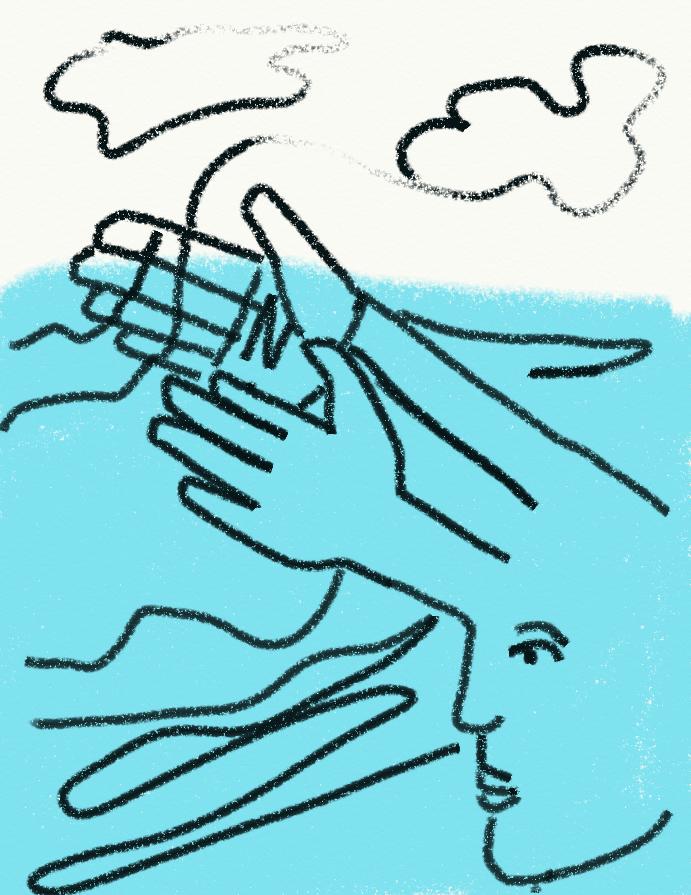
This is the image for the sign for "open-mindedness" that I came across in a sign language book. As hands hold special interest for me, it is appealing to think of the gesture having additonal significance. The resulting image is a lot like a sign, with its clarity and legibility. I am fascinated that the pictorial translation of the action allows for the hands and forearms to be outgrowths of the head, the mind. I chose a peaceful sea and sky to envelope the figure, connoting the tranquility of openmindedness. To be open-minded is to be receptive to new ideas and experiences, without losing oneself in the process. In this sense it connects to the exploration I am doing in self-portraiture as well as to our politically divided nation and global conflicts.
One hand almost appears to hold a cloud on a string, like a kite. The line/string is a part of the folds of the fingers, which becomes cloud and current. It is the transparency of the "upper hand" that reiterates the theme. The diction is concise, as is Chinese landscape painting. It is also a quality in Guston drawings, which I aspire to, and was fortunate to see this week at McKee Gallery.

Sunday, November 12, 2006

Lunar Moth Self-Portrait


oil on panel, 36" x 42"
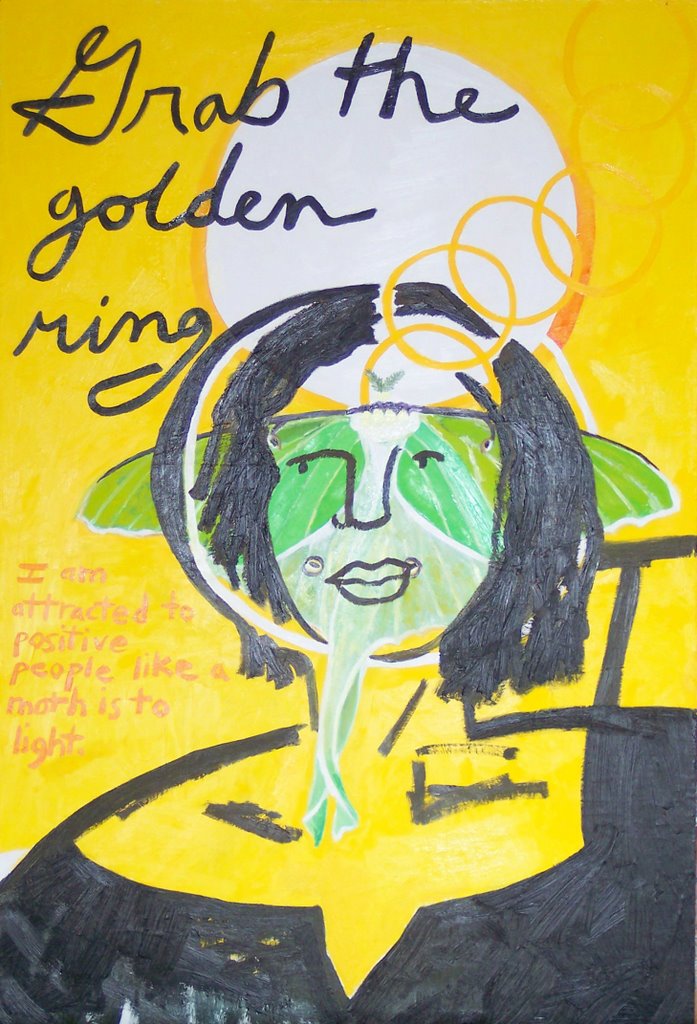
I seem to be on a roll with the self-portraits. This one owes a lot to the use of the tablet as a tool to reconstruct an image. It adds to the content of the Lunar Moth digital image from last week's post. I like that the moth looks like it just flew through my head, but is also a part of my head. Art that addresses spirituality has to love the ephemeral. It is painted in a way that combines technical control and loose brushwork. Modern dance has that precison of form combined with improvisation and visceral movement. Something about the flatness and division of shapes remind me of Mondrian, who was very exacting and painted to jazz.
I had an uncle who was an artist who has always been my role-model on how to live. When I was a little girl, he grabbed the brass rings for me while I rode on the carousel. He also gave me a tiny, gold ring when I was a baby. Those gold rings coming out of my head symbolize the people who have died who have made an impact on my life. "Grab the golden ring" is a "carpe diem" equivalent for me, but here it also suggests holding onto what is impossible to touch.
There is a large contrast between this new self-portrait and Self-Portrait Stepping Over a Threshold. Coming back home after the show in NYC, where I returned to family, friends, and my routine (including making art for the love of it), brought me back to center. It is a self-confident self-portrait. I also hope to be a positive person for others, as they are for me. There is a second way of looking at the head, if one follows the white curve on the left as the back of the head. It reminds me of "the man in the moon." Also in the fairy-tale vein, the head, end of the moth, and the manner that they are painted resemble an illuminated letter "Q", a cirle and tail. The "Q" would be for "queen" (not how I feel when I am cleaning the bathrooms), a metaphor for a strong sense of self (perhaps artistic self), solidity, autonomy. I've been interested in doing some things with crowns as spin-offs of the gold rings.
The painting was completed as the news came in regarding the Democrats taking the House, leading in the Senate, and Rumsfeld resigning. This change in government along with new innersoles gives me an extra bounce at Jazzercise and makes it feel as if Christmas has come early.
The moth wings also make for some funky sunglasses.

Sunday, November 05, 2006

Lunar Moth


digital image

I am continuing to use linked circles. "Grab the golden ring" refers to the brass rings on the first carousels. Children tried to grab them while riding in order to win an extra time around. For me, they are about claiming one's life in an affirmative way, making the decision to live rather than exist, even if it means struggle. I will go further and say that reaching for the ring is an act of striving. The striving is not about productivity or the accumulation of wealth, but rather an openness to change and the pursuit of self-development. The rings are not here to symbolize an attempt to lengthen one's life, as if one could buy more time or cheat death, getting an extra turn on the carousel of life.
Lunar moths live about a week. The moths transform themselves in their short lifespans and become beautiful. Some people may say they are beautiful in every stage. "I am attracted to positive people like a moth is to light," is self-explantory. I love being around people who are not burned out, who have contagious enthusiasm; the kind of people that "light up a room." As we experience the darkness in the world, it is important that we don't allow it to hinder us in our paths into becoming our best selves. That is why twelve-step programs advocate removing oneself from the people, places, and things that encourage negative behavior.
Obviously there is a play on the word "lunar" here between the moth and the moon. The large circle, emanating light as well as gold rings, is the moon, but is also symbolic of the divine.

Sunday, October 29, 2006

Christoph and Nicole


oil on panel, 21" x 25" and charcoal on paper, 18" x 24"
Here is another self-portrait, this time a painting and a drawing with my husband. The painting came first. It owes something to Charlotte Salomon (see links). The painting has the figures fused with a mountainous landscape while the drawing gives little reference for place.
In the drawing, I imposed the interlocking rings I have been using in other paintings over our heads, here reminders of wedding rings and marriage. Our son has been studying venn diagrams at school and I noticed that my image is one of sorts. "A venn diagram is a diagram used to divide up two or more objects to view similarities and differences. " - http://en.wikipedia.org/wiki/Venn_diagram It is unlike Picasso's Girl Before a Mirror at the MOMA (a painting with lots of rings) in that there are two figures here and they retain their separate identities. http://blog.chosun.com/web_file/blog/438/5938/1/picasso-Girl-Before-a-Mirror_small.jpg While there isn't a mirror in the picture, the mutual gaze relates to the psychological idea of "mirroring."
In the drawing, we do not seem to be gazing exactly into each other's eyes. I think Christoph is looking a bit outward while I seem to look a bit inward. Perhaps we don't always see eye-to-eye, but we have enough common ground to make a solid unit and to complement one another.

Sunday, October 15, 2006

Tug of War (Letting Go)


22" x 24", oil on canvas, 2006. Thanks to Rob S. for his post regarding Tug of War (Mass Grave II). It gave me the idea for this one. I liked his response that one can always let go. Sometimes the struggle, competition, and desire for the goal are so intense that letting go does not even cross one's mind as an option. This goes beyond the game, of course, and can apply to many things aside from war. That is what is great about art; a specific concept can reveal itself to be a common thread to diverse areas in life.
The hands in the picture seem to express a shock of realization, as if they are surprised to be letting go of the rope. They have a relationship with the figures, whose "v" shaped legs reflect the fingers. There is something here about being an individual and belonging to a group. The three figures are on the same team, but at a distance, their individuality is diminished. The hands are a pair to just one person, but the fingers are actors here, in rows, parts belonging to a whole. They are also all made out of red lines, like the umbilical cord rope; blood is at stake while the same human blood runs through all.
The visual syntax is distilled; the end of the rope looks like a thumbnail, color is reduced, description is secondary to the action. The hands also seem like wings, almost forming the shape hands make for a bird shadow puppet. Letting go is freeing.